
How could this be? How is it possible that Israel was founded as a democracy?
- Nir Topper

- Feb 7
- 5 min read
Updated: Mar 4
How did a state born in 1948 into the storm of an existential war—absorbing millions of immigrants, most (if not all) of whom had never lived under a democracy, and grappling with profound religious and ideological schisms—choose to declare itself a democratic regime?
From a historical-comparative perspective, Israel is an anomaly. Most new nations created in the 20th century that began as democracies collapsed into totalitarian regimes within a short time (Syria, Ghana, Myanmar, and Pakistan are just a few examples). The natural tendency is to think that Israeli democracy was a momentary decision made on the 5th of Iyar, or a stroke of brilliance by David Ben-Gurion. But the truth, as revealed by deep historical analysis, is far more fascinating: Israeli democracy was not "born" in 1948; it was forged decades earlier.
The Roots of the "Democratic Genome"
The seeds of Israel’s democratic genome were planted in Basel in 1897. Long before the Jewish people had a territory, they had a democracy. Theodor Herzl built the Zionist Congress as a fully functioning parliament with an ingenious mechanism: the "Zionist Shekel." Only those who paid membership dues earned the right to vote, creating a direct link between the citizen and the institution.
And what is truly remarkable? Even then, at the end of the 19th century, women were granted the right to vote—decades before most "enlightened" Western nations. The system chosen was proportional representation, designed to prevent divisions and allow every faction—socialists, religious, and liberals—to feel like part of the game. This is a classic case of historical "Path Dependence" that set the rules of our game to this day.
A Tradition of Self-Governance
Herzl did not build this democracy in a vacuum; he leaned on an ancient and surprising tradition of Jewish self-management. As far back as the 16th and 18th centuries, the "Council of the Four Lands" operated in Poland as an autonomous Jewish parliament that collected taxes and managed judicial affairs.
This tradition continued into modernity with civic organizations like the Central Association of German Citizens of Jewish Faith (C.V.), which served as a model for democratic civic organization within a hostile environment. When the pioneers of the various Aliyah waves arrived in Israel, they brought this fervor in their backpacks. Youth movements like Hashomer Hatzair were not just scouting groups; they were political schools in every sense, managing communal life, holding stormy votes, and educating for collective responsibility. Even synagogues in Jewish communities had always served as a public space for debate and decision-making. Thus, a foundation of civil society was created—one that knew how to organize itself without waiting for a central government.
The State-in-the-Making
Throughout the first half of the 20th century, the Jewish people refined these institutions into a "State-in-the-making." The World Zionist Organization and its congresses served as the global legislative branch; the Jewish Agency functioned as the de facto executive government ("The Executive") vis-à-vis the British Mandate; and within the land, Knesset Yisrael (with the Assembly of Representatives and the National Council) managed daily life—from education to health—almost entirely autonomously.
Even the Histadrut (General Federation of Labor), established in 1920, was much more than a labor union; it was an entire economic and political ecosystem that built the country. When Ben-Gurion declared independence, he didn't have to build government ministries from scratch; he simply converted the departments of the Jewish Agency and the National Council into government offices, and the Assembly of Representatives into the Knesset. The skeleton was already there, functional and ready.
The Democratic Laboratory
During the Mandate period, the Jewish Yishuv lived within a unique "democratic laboratory." These institutions had no police force or prisons. Their entire authority stemmed from voluntarism—the free consent of the public. This situation fostered a political culture of "Consociational Democracy": leaders understood they could not force decisions by a slim majority because the minority would simply leave. Thus, they developed the art of coalitions, compromises, and the "Status Quo."
The Ultimate Test: May 12, 1948
One of the most dramatic moments proving the strength of this democratic DNA occurred on May 12, 1948, two days before the Declaration of Independence. The People’s Administration (the provisional government) gathered to decide whether to declare a state and risk a total Arab invasion or accept the American proposal for a truce. Contrary to myth, Ben-Gurion did not simply bang on the table and dictate the outcome. A democratic vote was held. The result was 6 in favor of the declaration versus 4 against. The fact that such an existential decision was made by a margin of two votes—and that the dissenters accepted the verdict and immediately joined the war effort—is the ultimate proof of the institutional resilience of the young state.
The Mystery of the Missing Word
A historical trivia point many miss: the word "democracy" is absent from the Declaration of Independence. This was not accidental. Early drafts (such as that of jurist Zvi Berenson) explicitly included the word, but it was eventually omitted. The reasons remain a matter of speculation.
I tend to believe that by not merely using the label "democracy"—which requires interpretation—but instead detailing the foundational values, the document provides a deeper liberal and free essence. By stating the state will "ensure complete equality of social and political rights to all its inhabitants irrespective of religion, race or sex" and "guarantee freedom of religion, conscience, language, education and culture," the Declaration defines democracy through action and ethics rather than just a title.
👉Join my (quiet) WhatsApp channel - Society, Culture & History:
Bottom Line
Looking at Israel’s political system, it is important to remember: it is not perfect, but it is a miracle of stability. Most importantly: it is absolutely not a given! Israeli democracy was not a gift granted to the people; it was a muscle trained for decades before the state was even established. The secret that allowed Israel to survive in one of the world's most challenging regions is the combination of strong institutions, a tradition of proportional representation, and the capacity to contain contradictions. This is the story of a people who decided to be democratic even before they decided exactly where they would do so.
Image: Herzl speaking at the Second Zionist Congress in Basel. Source: Wikipedia.

Image: Zionist institutions until WWI. Source: Nir Topper.

Image: Election campaigns for the four Assemblies of Representatives. Source: Nir Topper.

Image: Dr. Chaim Weizmann and his wife voting in the Constituent Assembly elections, 1949.
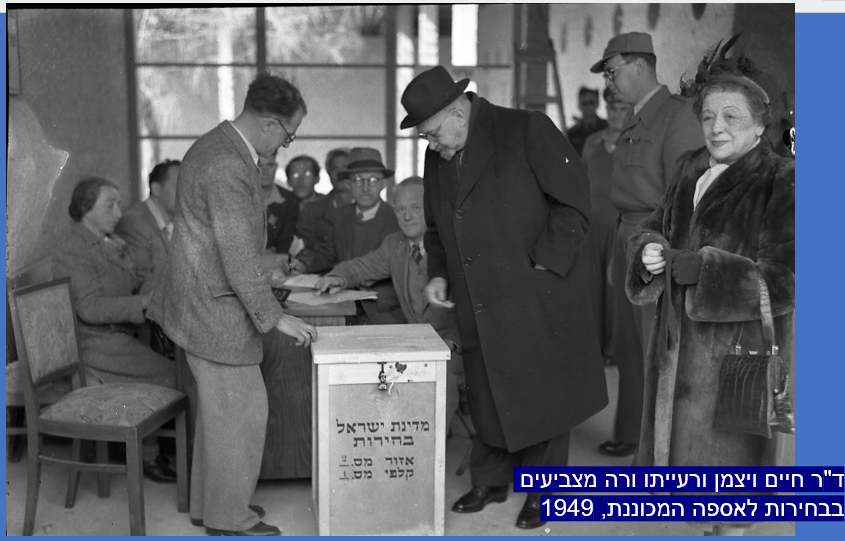
Image: Data and results of the Constituent Assembly elections, 1949. Source: Nir Topper.


Comments