
3,000 Years of Synergy: A Glimpse into the Place Where Man and Nature Refuse to Stop Talking

Ein Karem is more than just a picturesque neighborhood; it is a living "Cultural Landscape." (A "Cultural Landscape" is a geographic area representing the combined work of nature and man over time). It expresses a rare reciprocity between humanity and the environment spanning over 3,000 years. Its origins date back to the Middle Bronze Age (2,000–1,550 BCE), centered around "Mary's Spring," a perennial layer spring. For millennia, this spring fed a magnificent system of terrace farming—physical evidence of how human hands have shaped the terrain across generations.
In Arabic, the spring is called "Ein Sitti Maryam" (The Spring of Our Lady Mary), following a 14th-century Christian tradition that Mary, the mother of Yeshua, drank here on her way to visit Elizabeth. This name was documented as early as the 1881 PEF (Palestine Exploration Fund) report. Interestingly, a mosque was built directly above the spring—a fascinating expression of the intersecting religious layers in Ein Karem. An inscription in the mosque's courtyard dates it to 1828–1829 CE (1244 AH).
Ein Karem’s textual roots run deep: the Septuagint preserves the name "Karem" in Judah, and the Prophet Jeremiah mentions "Beth Hakkerem" as a strategic beacon station. During the Return to Zion, it became an administrative center, as recorded in Nehemiah: "Malkijah the son of Rechab, the ruler of the district of Beth Hakkerem" (Nehemiah 3:14). Renowned scholars such as Albrecht Alt and Michael Avi-Yonah identify the biblical site with modern Ein Karem based on archaeological finds from the Iron and Hellenistic periods.
The connection to the "Holy of Holies" is equally moving: the Mishnah notes that "they used to bring stones for the ramp and stones for the Altar from the valley of Beth Hakkerem" (Middot 3:4). The smooth local limestone allowed for the quarrying of whole stones without the use of iron tools, as required by Jewish Law (Halakha). Thus, the village valley became the provider of the purest materials for the Altar during the Second Temple period.
For the Christian world, Ein Karem is the setting for key theological moments. It was the home of Zechariah and Elizabeth, the parents of John (later the Baptist). It was here that the foundational "Visitation" took place—the meeting between Elizabeth, pregnant with John, and her cousin Mary, pregnant with Yeshua. The birth of John the Baptist sanctified Ein Karem as a major pilgrimage site. The "Magnificat" (The Song of Mary), a Christian hymn of praise, is traditionally believed to have been sung by Mary during this visit, after being told by the Angel Gabriel that she would bear Yeshua. Taken from the Gospel of Luke, this text has inspired countless musical masterpieces, particularly during the Renaissance and Baroque periods.
During the Middle Ages, the Crusaders (12th century) erected the church of "Sanctus Johannes in Montibus" (Saint John in the Mountains). After the conquest of Jerusalem by Saladin in 1187, the village was granted to the mystic Sheikh Abu Madyan of Seville, a famous Sufi teacher from Andalusia. Saladin's son, Al-Afdal, established a Waqf in 1193 to support Maghrebi pilgrims in Jerusalem. The official Waqf, including Ein Karem, was consolidated in 1320 by Abu Madyan’s great-great-grandson. From then until 1948, the agricultural revenues of Ein Karem supported thousands of North African Muslim pilgrims and maintained the Maghrebi Quarter in the Old City.
The architectural Golden Age arrived in the 19th century with what we call the "Penetration of the Powers"—the entry of European empires into the Holy Land. Architect Antonio Barluzzi designed the modern Church of the Visitation, incorporating ancient remains. Alongside it, monasteries like the Russian "Moscovia" (Gorny Monastery) were built, featuring the famous golden domes that give the village the spectacular international skyline it is known for today.
👉Join one of my (quiet) Channels - Society, Culture & History:
Telegram: https://t.me/nirtopper
Today, Ein Karem is an open-air museum blending art, history, and nature. Despite the modernization surrounding it, it manages to maintain its pastoral character, telling the story of the Land of Israel—from ancient agriculture to the modern preservation of a living, breathing cultural landscape.
Image 1: The Church of the Visitation, Ein Karem. Photo: Nir Topper.
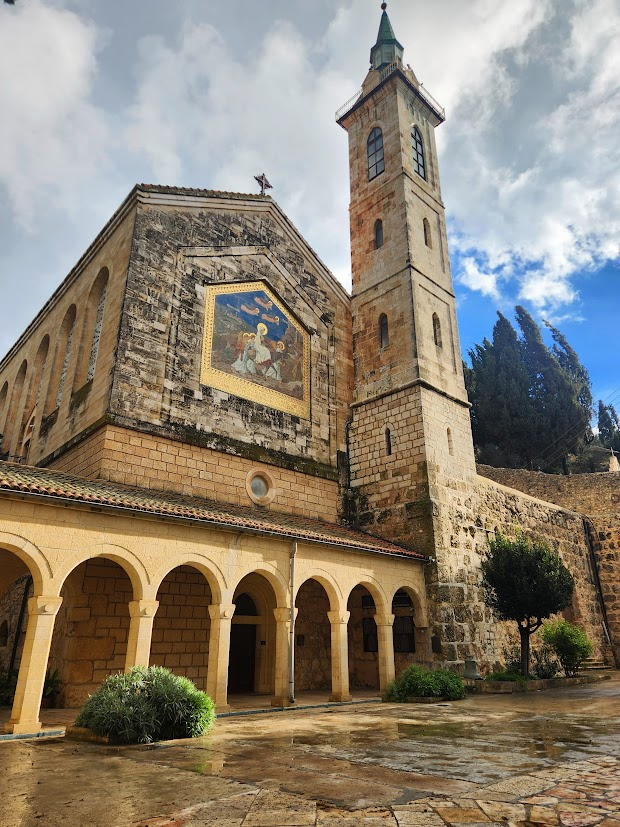
Image 2: Statue of Elizabeth and Mary, located in the courtyard of the Church of the Visitation, Ein Karem. In the background, on the wall: The Magnificat prayer in various languages. Photo: Nir Topper.

Image 3: The Moscovia (Gorny Monastery), Ein Karem. Source: Hagai Agmon-Snir, CC BY-SA 4.0, via Wikimedia Commons.

Image 4: Ein Karem in the PEF map, from the survey conducted by the Fund between 1871–1878. Source: PEF, Public domain, via Wikimedia Commons.

👉Join one of my (quiet) Channels - Society, Culture & History:
Telegram: https://t.me/nirtopper
--
---
----
#nir_topper #tour_guide #archaeology #history #society #israel #travel #culture #ניר_טופר #מורה_דרך #ארכיאולוגיה #היסטוריה #ישראל #טיולים #תרבות #חברה #EinKarem #Jerusalem #Heritage #UNESCO #JohnTheBaptist #HolyLand #עין_כרם #ירושלים #מורשת #נצרות #יהדות #LandscapeArchaeology #LandOfIsrael #נוף_תרבות