
The Zionist Strategy: Building a University Before Building a State!
- Nir Topper

- 4 hours ago
- 4 min read
In the summer of 1918—on Wednesday, July 24 (Tu B'Av 5678)—in the midst of World War I and while the northern part of the Land of Israel was still held by the Ottoman army, nearly 6,000 people gathered on the summit of Mount Scopus for an extraordinary event: the foundation stone-laying ceremony for the Hebrew University, destined to become the first university in the Land of Israel.
Dr. Chaim Weizmann, who would become the first President of the State of Israel 30 years later, delivered the keynote address. The ceremony was attended by General Allenby, who just seven months earlier, in December 1917, had entered Jerusalem as its liberator from Ottoman rule. Highlighting the unique nature of the event, the attendees and stone-layers also included the Mufti of Jerusalem, Kamil al-Husseini, and the Anglican Bishop.
Even before the national institutions of the Jewish National Home were established, and before there was any consensus on the nature of the future political entity, the leaders of the Zionist movement chose to establish a world-class spiritual, cultural, and scientific center—specifically in Jerusalem. The choice of Mount Scopus was no accident. The summit, rising to an elevation of approximately 826 meters above sea level—about a hundred meters higher than the Old City—offers a dual vista of profound symbolic significance: to the southwest lies the basin of the Old City and the Temple Mount, a view linking the modern Zionist enterprise to Jerusalem’s historical and spiritual past; to the east, a wild, open landscape unfolds toward the Judean Desert, the Dead Sea, and the Moab Mountains.
The ceremony took place in the late afternoon toward sunset—a detail Weizmann himself recalled in his memoirs, describing the breathtaking view from the mountain as the setting sun illuminated the Moab Mountains and the Dead Sea.
The story of acquiring the land for the historic campus began in the late 19th century, when Sir John Gray Hill, a wealthy British attorney from Liverpool, purchased a large plot on the summit and built a magnificent summer estate. In 1914, just months before the outbreak of World War I, Dr. Arthur Ruppin, director of the Palestine Office of the Zionist Organization, recognized the immense value of the property for the institution of higher education that the Zionist Congress had approved a year prior. When Gray Hill sought to sell, Ruppin acted with great resourcefulness and personal risk: without consulting anyone, he advanced 30,000 francs—secured from the Hovevei Zion committee in Odessa—to secure the purchase rights. Gray Hill passed away shortly thereafter, and the outbreak of the war cut off all communications. It was only toward the end of the war, thanks to a generous donation from Yitzhak Leib Goldberg—"The Unknown Benefactor"—who covered the bulk of the cost, and Gray Hill's widow, who honored the agreement, that the transaction was completed and the land was registered under the Jewish National Fund (KKL). This acquisition secured the university's first significant land anchor on the mountain.
The road leading to the Mount Scopus campus, bordering it from the south, is named "Yitzhak HaNadiv" (Yitzhak the Benefactor)—specifically after Goldberg, and not after Baron Rothschild as many commonly assume.
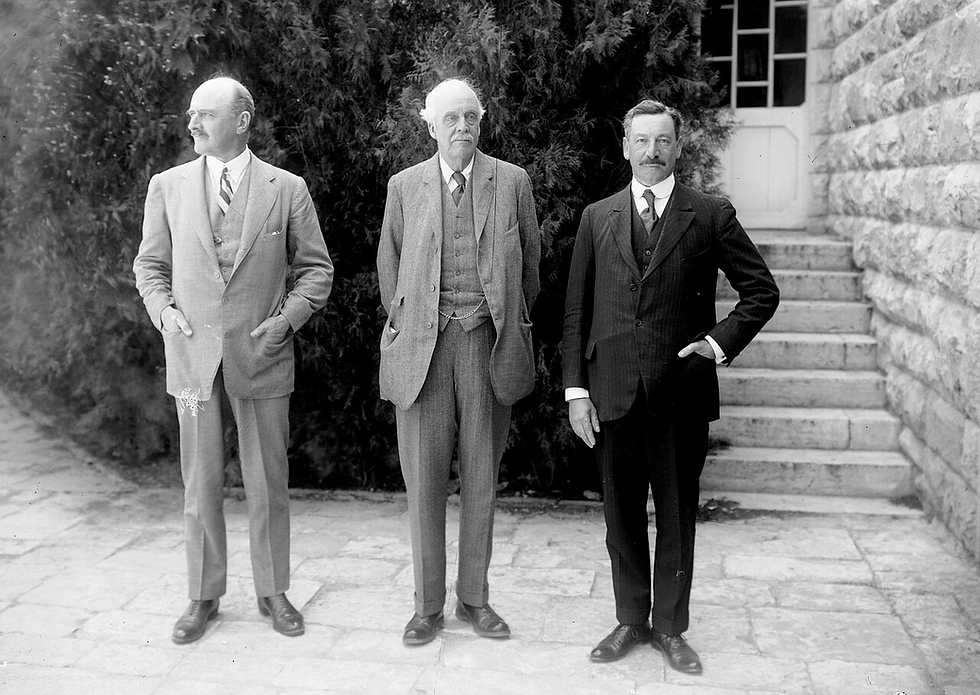
Nearly seven years later, on April 1, 1925, the university was officially inaugurated in an impressive international ceremony held at the open-air theater built on the mountain. Before an audience of about 12,000 people—at a time when the entire Jewish community (Yishuv) numbered only around 140,000 souls—speeches were delivered by Lord Balfour, Chaim Weizmann, Rabbi Kook, the High Commissioner Herbert Samuel, and the national poet Chaim Nachman Bialik, in the presence of university delegates and delegations from around the world.
The establishment of the Hebrew University on Mount Scopus represents one of the most fascinating chapters in the history of Zionism and Israeli society: the profound insight of a national movement in its infancy which, even before securing its physical or material might, prioritized education, science, spirit, and culture. The mountain, which began as an isolated summer estate, transformed over the years into a fortress of knowledge and one of Israel's central hubs of research.
The connection between the university and the giants of Jewish science was symbolized by Albert Einstein. He had already lectured on Mount Scopus in 1923 regarding the Theory of Relativity, served on the Board of Governors, and during the opening celebrations, the cornerstone was laid for the Institute of Physics and Mathematics that bears his name.
--
---
----
👉Join one of my (quiet) Channels, stay updated:
Telegram: nirtopper.com/telegram-channel
Whatsapp: nirtopper.com/whatsapp-channel
👉Rich content available for you on my Blog; Israel's History, Society & Culture:
Photos from the foundation stone-laying ceremony for the Hebrew University on Mount Scopus, Jerusalem, July 24, 1918. Images: Photograph Collection, The National Library of Israel, The Pritzker Family National Photography Collection, The National Library of Israel


.


Comments