
More Than Just a Port: A Geopolitical Barometer

Many of us perceive Haifa Port as an established fact, but history tells a completely different story. For the vast majority of history, Haifa was nothing more than a humble fishing village overshadowed by the giant that was Acre—the Crusader capital and the region's central port city. The dramatic turnaround only began in the mid-18th century, when the Bedouin ruler Dhaher al-Omar made a bold decision in 1761: he razed ancient Haifa to the ground and relocated the entire town eastward, to a more protected point between the sea and the mountain. This move, combined with changing technology arriving about a century later—steamships replacing sails, requiring deep waters that silt-filled Acre could not provide—marked the beginning of Haifa's era as a maritime power, even before the British Empire entered the picture.
However, the most significant physical transformation is an engineering marvel that many pass by without realizing they are walking on water. In the 1930s, British engineers were not satisfied with what nature provided; they reclaimed a massive strip of sea, approximately 360 dunams (90 acres), to create "Kingsway" (today's HaAtzmaut Road) and the port quays. They dredged millions of cubic meters of sand from the seabed, using it to create new land ex nihilo. The British motivation was purely strategic: creating a secure Mediterranean outlet for Iraqi oil piped from Kirkuk to Haifa, and turning the bay into a rear base for the Royal Navy in the struggle against the Nazis and in imperial competition.
A quick leap to the present reveals that history repeats itself, though the players have changed. The historic privatization of the port in 2023, in which it was sold to the Adani-Gadot Group (Indian-Israeli ownership: Adani ~70% and Gadot ~30%) for the staggering sum of 4.1 billion NIS, is not merely an economic transaction but a distinct geopolitical move. Haifa Bay has become an arena of collision between the new superpowers: on one side, the new "Haifa Bayport," opened for commercial activity in September 2021 and operated by the Chinese port giant SIPG (Shanghai International Port Group) under a franchise; on the other, the veteran port now under Indian-Israeli ownership. This competition can be seen as a reflection of the global struggle over trade routes—between China's "Belt and Road Initiative" (a Chinese strategy to create a vast network of transportation, energy, and trade infrastructure connecting China with the rest of the world) and the vision of the "India-Middle East-Europe Economic Corridor" (IMEC), promoted by the US, India, and Europe (an international economic and geostrategic initiative aiming to create a modern, extensive connectivity route linking India, the Middle East, and Europe).
The data on the ground proves that Haifa is once again the "Gateway to the East." While the Port of Eilat is almost completely shut down due to security threats, Haifa's ports have broken records and demonstrated critical operational resilience during the "Swords of Iron" war, just as the port served as the country's "lifeline" in 1948. The competition between the automated Chinese port, which already surpasses the veteran port in container volume, and the Indian-Israeli port, which also focuses on tourism and general cargo, seeks to ensure that Haifa remains a central nerve center in the global economy.
The next time you look out from the top of Mount Carmel towards the bay, don't just see cranes and shipping containers. See history moving in circles: from Dhaher al-Omar's vision, through British imperialism, to the power struggles of the 21st century. Haifa Port is much more than concrete infrastructure; it is a sensitive seismograph measuring the pulse of history, the economy, and the politics of the entire region.
Image: Haifa Port in 1930 (The Association for the History of Haifa). Image Source: https://haipo.co.il/item/332174
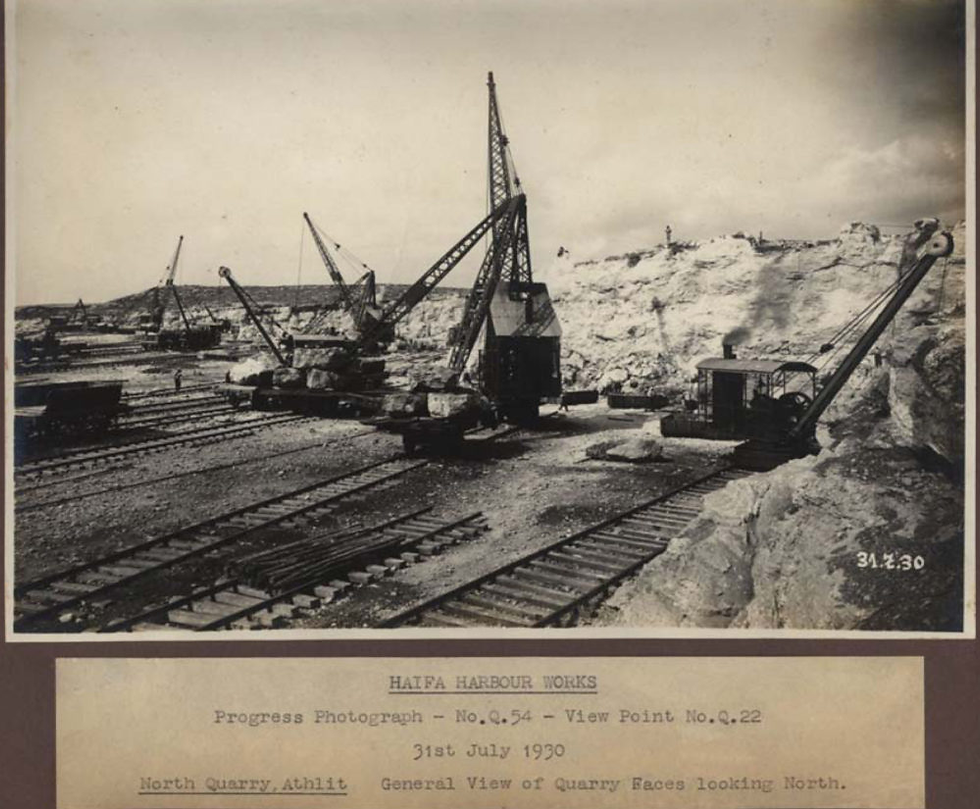
Image: Haifa Port and the Lower City, 1935, the port is still in the reclamation stages. Photographer: Ze'ev Aleksandrowicz. Image Source: https://www.facebook.com/share/p/1AaT4YM2fC/

Image: Reclaiming the sea, construction of Haifa Port, 1930. Image Source:

Image: Haifa Port, 2026. Image Source: https://haipo.co.il/item/607287
