
The Neighbors Across the Cave: The Mount Carmel Secret and the Encounter that Changed Human History
- Nir Topper

- Mar 18
- 4 min read
Updated: Mar 22
Nahal Me'arot (the Caves of Mount Carmel) is far more than just an impressive nature reserve; it is one of the most significant prehistoric sites in the world, recognized as a UNESCO World Heritage Site since 2012. The site preserves a rare cultural sequence spanning approximately half a million years of repeated human settlement. The four primary caves—Tabun, Jamal, el-Wad, and Skhul—serve as an extraordinary biological and cultural archive, representing critical milestones in the development of the human race.
The Story of Discovery: From Quarry to World Heritage
The discovery of the site is deeply intertwined with the history of the British Mandate. In 1928, the cliff was slated to serve as a quarry for the construction of Haifa Port. The British Mandate's Department of Antiquities dispatched archaeologist Charles Lambert to survey the area. His findings—including a unique prehistoric bone carving and two ancient burials—established the scientific importance of the site and saved it from destruction. This led to large-scale international research. Between 1929 and 1934, British archaeologist Dorothy Garrod led an excavation expedition whose scientific core and workforce were composed primarily of women—an exceptional phenomenon at the time—laying the foundations for multidisciplinary prehistoric research in the Levant.
Tabun Cave: The Chronological Heart
Tabun Cave (the Oven) sits at the heart of the site’s chronological sequence, featuring archaeological layers approximately 25 meters thick that represent the Lower and Middle Paleolithic periods. It was here that evidence of the regular use of fire dating back 350,000 years was uncovered, alongside the world’s oldest known grinding tool—a rounded dolomite pebble used for processing soft materials such as animal hides. The most notable human find in the cave is the skeleton of a Neanderthal woman (Tabun C1), considered one of the most complete Neanderthal skeletons ever found in the Levant.
Skhul Cave: Rethinking the "Out of Africa" Theory
In the nearby Skhul Cave (the Kid), discoveries were made that fundamentally changed our understanding of Homo sapiens' migration out of Africa. Ten skeletons of anatomically modern humans (Homo sapiens), dated to between 100,000 and 135,000 years ago, significantly predate the appearance of Homo sapiens in Europe. Findings in Skhul Cave, such as the Skhul V burial—where a wild boar mandible was placed on the deceased’s chest—and perforated seashells likely used as ornaments, provide evidence of symbolic behavior and burial rituals long before the "Great Revolution" associated with the Upper Paleolithic in Europe (which began 40,000–45,000 years ago).
A Crossroads of Species
One of the most sensational scientific contributions of Nahal Me'arot is its challenge to the linear view of human evolution—the approach that saw evolution as a simple process of one species being replaced by another. The findings indicate that Neanderthals and Homo sapiens coexisted in the Levant during overlapping or adjacent periods for tens of thousands of years (between roughly 130,000 and 45,000 years ago), utilizing similar technology known as the Mousterian culture (a Middle Paleolithic stone tool industry). Recent genetic and morphological studies even suggest that the Levant served as a crossroads for social interaction and biological interbreeding between these populations.
el-Wad Cave: The Transition to Permanent Settlement
el-Wad Cave (the Stream) represents the crucial transition from hunter-gatherer societies to permanent settlements during the Natufian period (named after Wadi an-Natuf in the Judean Hills, where it was first identified), roughly 11,500 to 15,000 years ago. On the terrace in front of the cave, remains of stone structures, a communal cemetery with about 100 burials, and intricate decorative items like Dentalium shell necklaces were uncovered, pointing to a complex social life. The Natufians developed a society whose economy included systematic gazelle hunting alongside the harvesting and processing of wild grains using stone grinding tools, enabling a sedentary or semi-sedentary lifestyle.
👉Join one of my (quiet) Channels - Israel's History, Society & Culture:
Telegram: nirtopper.com/telegram-channel
Whatsapp: nirtopper.com/whatsapp-channel
Today, Nahal Me'arot continues to be a focal point for international research, teaching us about the human capacity to adapt to drastic climate changes. The place where two human species met remains a living testimony to the complex human journey, reminding us that our history is not a straight line, but an intricate tapestry of encounters, cultures, and coexistence.
Image 1 – Tabun Cave, Nahal Me’arot. Photo: Nir Topper. The archaeological stratigraphic section in Tabun Cave. Layers G, F, and E belong to the Lower Paleolithic, while layers D, C, and B belong to the Middle Paleolithic.

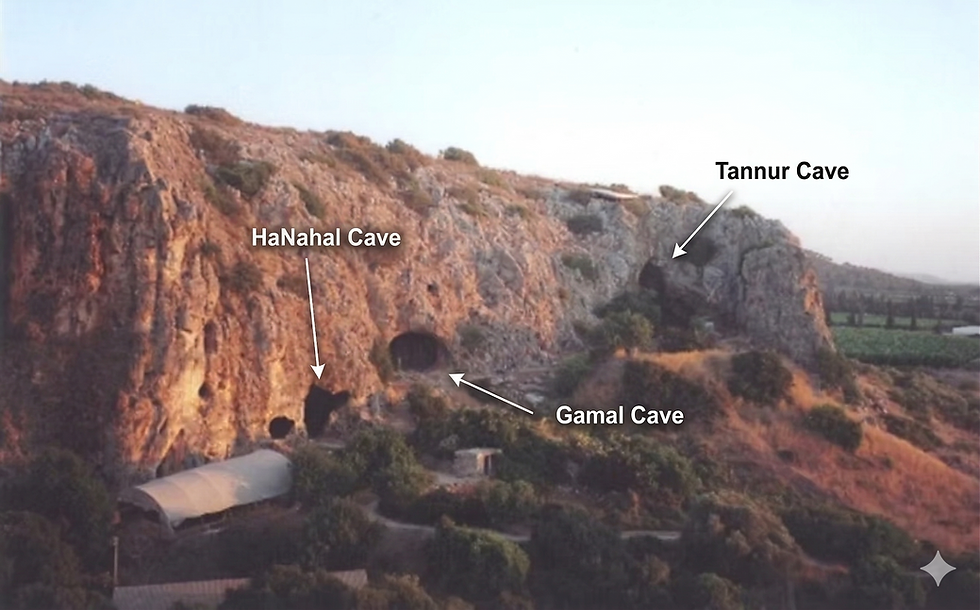
Image 2 – The Nahal Me’arot cliff, view facing southeast. From right to left: Tabun Cave, Jamal Cave, and el-Wad Cave with its terrace (partially covered). Skhul Cave is located about 100 meters east of the three caves shown. Source: Wikipedia, Nahal Me'arot. R Yeshurun, CC BY-SA 3.0 via Wikimedia Commons.
👉Join one of my (quiet) Channels - Israel's History, Society & Culture:
Telegram: nirtopper.com/telegram-channel
Whatsapp: nirtopper.com/whatsapp-channel
--
---
----
#nir_topper #tourguide #history #society #culture #israel #travel #tourism #archaeology #UNESCO #WorldHeritage #Prehistory #Evolution #Humanity #Neanderthal #HomoSapiens #ניר_טופר #היסטוריה #חברה #תרבות #ישראל #טיולים #תיירות #ארכיאולוגיה


Comments