
Between Batey Midrash and Hippos: The Secrets of the Galilee’s Most Cosmopolitan City – The "Nile Festival House" in Sepphoris
- Nir Topper

- May 2
- 3 min read
Sepphoris (Tzippori) was a central city in the Lower Galilee during the Roman and Byzantine periods, from the 1st century to the 7th century CE. While its origins date back to the Iron Age (10th century BCE), it continued to flourish throughout the Hellenistic period, eventually becoming one of the most important cities in the region.
In the late 2nd and early 3rd centuries, under the leadership of Rabbi Judah the Prince (Rabbi Yehuda HaNasi), Sepphoris served as a monumental Jewish spiritual center. According to tradition, it was here that the editing of the Mishnah was completed. Yet, at the same time, it remained a magnificent Hellenistic-Roman polis. This unique combination of Batei Midrash (Houses of Study) alongside a Roman theater, colonnaded streets, and pagan public buildings creates a rich cultural mosaic that makes Sepphoris one of the most fascinating cities in the ancient world.
The Nile Festival House
One of the most intriguing structures discovered in Sepphoris is the "Nile Festival House." This large-scale Byzantine public building is world-renowned for its breathtaking mosaic floors, dating back to the 5th century CE.
The central mosaic depicts the celebrations surrounding the rising water levels of the Nile in Egypt—an event that was critical to the economy of the Roman Empire and the entire Mediterranean basin. The artistic depiction features the figure of the Nile God reclining on a hippopotamus with water flowing from its mouth. Beside him, a figure climbs a Nilometer—a measuring column—to mark the abundance of the 17-cubit level. Nearby, the city of Alexandria is represented by a city gate bearing its name in Greek, alongside the famous Pharos Lighthouse.
A Mediterranean Connection in the Heart of the Galilee
The choice to decorate a Galilean public building with descriptions of a distant Egyptian festival likely points to the deep cultural affinity Sepphoris residents had for the broader Mediterranean world. For this community, the Nile was not just a river; it was a well-known symbol of abundance, fertility, and cosmopolitanism.
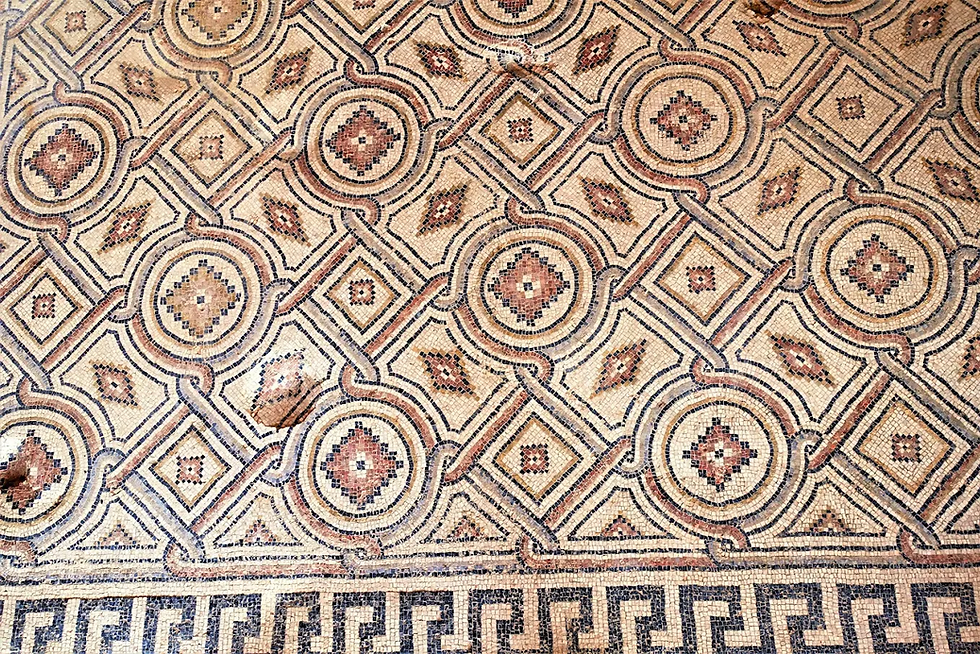
The building’s many rooms feature stunning mosaics with geometric patterns and figurative decorations, each with a unique design. This variety has sparked great curiosity among researchers trying to determine the building's original purpose. The sheer quality of the craftsmanship—utilizing dense tesserae (tiny mosaic stones) in eighteen different shades—makes this one of the most impressive Byzantine mosaic complexes preserved in Israel today.
What Was This Building For?
Scholars have offered several interpretations for the site:
A Municipal Basilica: Based on its size, central location near the Cardo, the dedication inscription at the entrance, and the lack of residential signs.
A Ritual Water Pavilion: A venue for water-themed celebrations, supported by the drainage channels found beneath the floor.
Other Theories: A commercial center, a courthouse, or even a leisure complex.
My Personal Favorite Interpretation
My favorite interpretation—not necessarily because it is the most "proven," but because it is the most charming and story-driven—is that the building served as a showroom or a catalog for mosaic artists. According to this theory, a patron could visit the central city of Sepphoris, enter the showroom, and browse various mosaic options to order for their own home or a public building in their community.
What do you think? What other possibilities could explain the meaning of the "Nile Festival House" villa?
--
---
----
Images of the Nile Festival Celebration Mosaic


Images of the various rooms in the Nile Festival House -



👉Join one of my (quiet) Channels:
Telegram: nirtopper.com/telegram-channel
Whatsapp: nirtopper.com/whatsapp-channel
👉Rich content available for you on my Blog; Israel's History, Society & Culture:
--
---
----


Comments