
"Summarizing Symbol" - The Roman Legions That Were Here, and Also: "Every Legion Has a Name"
- Nir Topper

- Jul 5
- 5 min read
A Summarizing Symbol is an anthropological concept that condenses an entire value system into one powerful emotional symbol.
Another stop on the Inquiry Journey I embarked on, "Flags and Symbols in the Land of Israel": The Roman Legions that were in the Land of Israel.
The Roman period in the Land of Israel (63 BCE to 324 CE) brought a cosmopolitan culture from the wider world into the small province. This included everything a global empire had to offer: fashion, music, technology, ceremonies, social codes, and also flags and symbols—including those of the Roman legions that arrived here.
Every legion has a name, as well as a number, and officially, a legion was supposed to consist of about 6,000 soldiers. At any given time, no more than two of them were permanently stationed in the country, but additional legions were dispatched here periodically as reinforcements during times of rebellion.
During the Great Revolt (66–73 CE), six different legions were involved in the fighting. Four of these participated in the siege of Jerusalem in 70 CE: the 5th, 10th, 12th, and 15th Legions. Of these, only the Tenth Legion (Fretensis) remained as a permanent garrison force after the destruction.
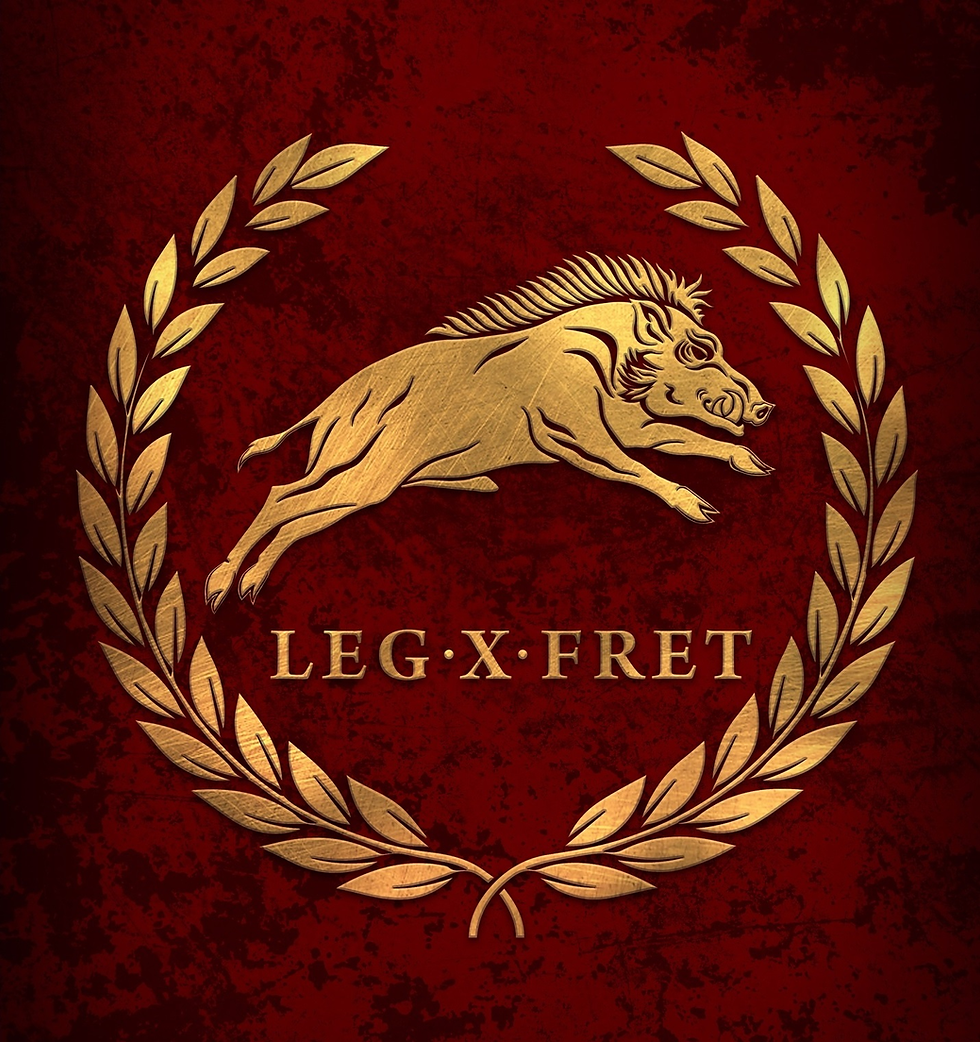
The 10th Legion Fretensis (Legio X Fretensis) bore several symbols—a bull, a warship, the god Neptune, a dolphin, and a wild boar. The boar appears frequently on its stamp impressions ("LEG X FRE"). Hundreds of remnants of roof tiles and bricks bearing these stamps have been discovered at various sites in Jerusalem, including Givat Ram and the vicinity of the southwestern corner of the Temple Mount.
The 12th Legion Fulminata (Legio XII Fulminata) - lightning bolt. During the hasty retreat from Jerusalem at the Battle of Beth Horon, the legion suffered a devastating defeat at the hands of the Jewish rebels and lost its eagle standard (the Aquila)—an event considered one of the gravest military disgraces in the Roman army.
The 5th Legion Macedonica (Legio V Macedonica) - a bull, and also an eagle. In 70 CE, this legion participated, alongside the 12th and 15th Legions, in the siege of Jerusalem on the western front of the city.
The 15th Legion Apollinaris (Legio XV Apollinaris) was named after the god Apollo and likely bore his image, although the exact identity of its symbol is not known for certain. The legion, commanded by Titus, was known primarily for the conquest of Yodfat (Jotapata) in the Galilee (67 CE), where Josephus Flavius was taken captive.
The 10th Legion remained stationed in Jerusalem for about 150 years, leaving behind a rich archaeological record (roof tiles, bricks, coins). The other three legions stayed in the Land of Israel only for the duration of the revolt itself (66–73 CE) and were subsequently stationed elsewhere (the Danube, Carnuntum, Cappadocia). Therefore, most of their direct archaeological finds (tombstone inscriptions, coins) come from the sites outside Israel where they were stationed for many years, rather than from Jerusalem or the land itself.
--
---
----
👉Join one of my (quiet) Channels, stay updated:
Telegram: nirtopper.com/telegram-channel
Whatsapp: nirtopper.com/whatsapp-channel
👉Rich content available for you on my Blog; Israel's History, Society & Culture:
Aquila (Eagle) - The symbol of the Roman army, which every legion carried with religious reverence alongside the legion's own specific emblem. The Aquila was the most important symbol of the legions in the Roman army and was considered a sacred, religious item. Its fall into enemy hands was viewed as a profound disgrace and a severe blow to the honor not only of the legion that lost it, but of Rome as a whole. The Romans invested immense efforts to retrieve their lost legionary standards, even many years after they were lost in battle. Image: Ornament with Eagle, 100-200 AD, Roman, gold - Cleveland Museum of Art. Source: Daderot, CC0, via Wikimedia Commons

Tetradrachm coin minted by Pescennius Niger with an eagle on the reverse, 193 CE.
Tetradrachm - An ancient silver coin common in the Greek and Roman world, equivalent in value to four drachmae.
Pescennius Niger - The governor of the province of Syria who declared himself Emperor of Rome in 193 CE (the "Year of the Five Emperors"), until he was defeated by Septimius Severus.
Image: By Classical Numismatic Group, Inc. http://www.cngcoins.com, CC BY-SA 2.5

Aureus coin minted in 193 CE by Septimius Severus to celebrate the Fourteenth Legion Gemina Martia Victrix (Legio XIIII Gemina Martia Victrix) – the legion that declared him emperor. Image: CNG, Public domain, via Wikimedia Commons

Reconstruction of the 10th Legion's symbol - Legio X Fretensis. Image: x-legio.com
Roof tile fragment with the stamp of the Tenth Legion Fretensis, "LG X F", and its symbols: a wild boar and a warship. Found in Jerusalem, 1st and 2nd centuries CE. The Israel Museum, Jerusalem. Image: Uploaded by Carole Raddato, published on 18 August 2021. The copyright holder has published this content under the following license: Creative Commons Attribution-NonCommercial-ShareAlike. https://www.worldhistory.org/image/14448/stamp-of-legio-x-fretensis

Tabula ansata - A Roman inscription indicating the presence of the Tenth Legion Fretensis (Legio X Fretensis). The inscription is integrated into the wall of the Crusader church at the Benedictine Monastery in Abu Ghosh. Dated to the 2nd century CE, it marks a Roman military detachment (Vexillatio) that operated in the area. Image: Willem van de Poll, CC0, via Wikimedia Commons

Milestone with a mention of the Tenth Legion Fretensis (X Fretensis). Dated to the years immediately following the destruction: 70–79 CE. The stone is located at the Davidson Center, Jerusalem. Image: x-legio.com

Reconstructed symbol based on archaeological finds of the 12th Legion, whose emblem was a lightning bolt. Image: https://x-legio.com/en/wiki/legio-xii-fulminata, Public domain, via Wikimedia Commons

Stamp of the 5th Legion, found in modern-day Turda, Romania. Image: CristianChirita, CC BY-SA 3.0 https://creativecommons.org/licenses/by-sa/3.0, via Wikimedia Commons

Burial inscription of a soldier from the Fifth Legion discovered in Nablus (Shechem). The inscription dates back to the Bar Kokhba Revolt (132–136 CE). It reads: "To the spirits of the departed, Marcus Ulpius Magnus of the Claudian tribe, a man of Savaria, centurion of the Fifth Legion Macedonica, lies here. Flavius Moderatus and Julius Ingenuus, centurions, saw to the erection (of this monument)." Image: The inscription is displayed at the Rockefeller Museum, free use, https://he.wikipedia.org/w/index.php?curid=848788

"Historical reenactors" – This is the term for people engaged in the living reenactment of military and civilian history, seen here recreating the departure of the 15th Legion from a reconstructed Roman military camp (castra) in Pram, Austria. Image: By No machine-readable author provided. MatthiasKabel assumed (based on copyright claims)., CC BY-SA 3.0 http://creativecommons.org/licenses/by-sa/3.0/, via Wikimedia Commons


Comments