
Once, Water Was Pumped Up; Today, It Flows in Reverse
- Nir Topper

- Mar 13
- 4 min read
Updated: Mar 17
The National Water Carrier (HaMovil HaArtzi) is the national backbone that enabled the shaping of Israel's geographic and demographic map. It represents the transition from a vision of settling the Negev to an engineering reality that ensured sovereignty and food security across all parts of the country. The project was conceived as early as the 1940s by Simcha Blass—a co-founder of the "Mekorot" water company, the architect of its primary plans, the chief designer of the National Water Carrier, and the founder of Tahal (Water Planning for Israel). It was born out of the necessity to bridge the gap between the water sources in the north and center and the aridity of the south.
The engineering vision of Simcha Blass was adapted to the political circumstances following the War of Independence. Alongside him stood Levi Eshkol, the "political architect" of the venture, and Pinhas Sapir, who mobilized the resources for its execution. The challenges were also security-related; the construction of the Carrier was accompanied by heavy tension with Syria, leading in the 1960s to the "War over Water" following attempts to divert the sources of the Jordan River.
From an engineering perspective, the Carrier is a technological marvel extending from the northern Sea of Galilee (Lake Kinneret) to central Israel. However, its practical operation began with the "Yarkon-Negev" line, which started flowing water from the Yarkon springs to the south as early as 1956. The main Carrier, in its expanded version, begins at the Sapir Site, which pumps water from approximately 210 meters below sea level to an elevation of 44 meters above sea level. Starting in 1964, with the completion of the national project, water began flowing south from the Kinneret. Throughout its route, creative solutions were employed, such as the Hukok Canal, which crosses the Amud and Tzalmon streams using "inverted siphons" (known in Hebrew as Gihonim) that utilize the law of communicating vessels, alongside a system of canals, reservoirs, and massive tunnels crossing the Samarian hills and the Ramat Menashe plateau.
Over the years, the Carrier underwent a significant shift in purpose. While initially most of its water was used for agriculture in the Negev, population growth increased the share dedicated to drinking water. In 2008, the Desalination Revolution began, and the water in the pipes became a blend of Kinneret water and desalinated water—a step that allowed for reduced direct pumping from the lake and the preservation of this natural resource.
Today, a new technological peak has been reached: "The Reverse National Water Carrier." This project enables the flow of surplus desalinated water northward to the Sea of Galilee as a response to climate change. The goal is the ecological restoration of the lake and its preservation as a strategic emergency reservoir and for international agreements. The system, expected to be fully operational during 2026, is already flowing approximately 5,000 cubic meters of water per hour into the lake.
As a result of long-term strategic planning combined with world-class expertise, experience, initiative, and the courage of exceptional individuals, the State of Israel successfully meets the immense challenge of providing water for private, agricultural, and industrial consumption. In 1948, Israel consumed about 300 million cubic meters of water (a research-based estimate); by 1990, it reached approximately 1,800 million cubic meters; and in 2025, it is estimated at 2,500 million cubic meters. Beyond these quantities, Israel also sells water to its neighbors. Today, desalinated water accounts for about half of Israel's total fresh water consumption, providing between 70% and 80% of domestic and municipal needs. Severing the link between demographic growth and reliance on precipitation is the fruit of strategic planning, which has transitioned Israel to a managed water economy that ensures existence in a semi-arid region without direct dependence on rainfall.
👉Join one of my (quiet) Channels - Israel's History, Society & Culture:
Telegram: https://t.me/nirtopper
The National Water Carrier remains the state's primary lifeline and a symbol of adaptability. The water flowing through it today ensures that the Sea of Galilee remains full and active—not just as a tourism asset, but as a strategic anchor to secure the country's future in times of emergency or in an unforeseen reality where desalination capacity might be insufficient for the population's needs.
Image 1: The route of the National Water Carrier. Source: MT0, CC BY-SA 3.0, via Wikimedia Commons.

Image 2: The Hukok Canal of the National Water Carrier, near Kahal. Source: Hagai Agmon-Snir. CC BY-SA 4.0 <https://creativecommons.org/licenses/by-sa/4.0>, via Wikimedia Commons

Image 3: The Amud Stream Siphon. Source: Hagai Agmon-Snir. CC BY-SA 4.0 <https://creativecommons.org/licenses/by-sa/4.0>, via Wikimedia Commons

Images 4-8 Source: The Central Zionist Archives http://www.zionistarchives.org.il/Pages/HamovilHaarzi.aspx
Image 4: Engineer Simcha Blass (From "Encyclopedia of the Founders and Builders of Israel" by David Tidhar).

Image 5: Workers fixing secondary pipes to the wall of the "Menashe Tunnel"—a 7 km long underground tunnel with a diameter of 3.5 m, excavated to transport filtered water from the Ein HaShofet area southward. Most of the excavation was done via explosives and later mechanical tools. (NCHS\493679)

Image 6: Mining works in the Menashe Tunnel. (NCHS\494180)
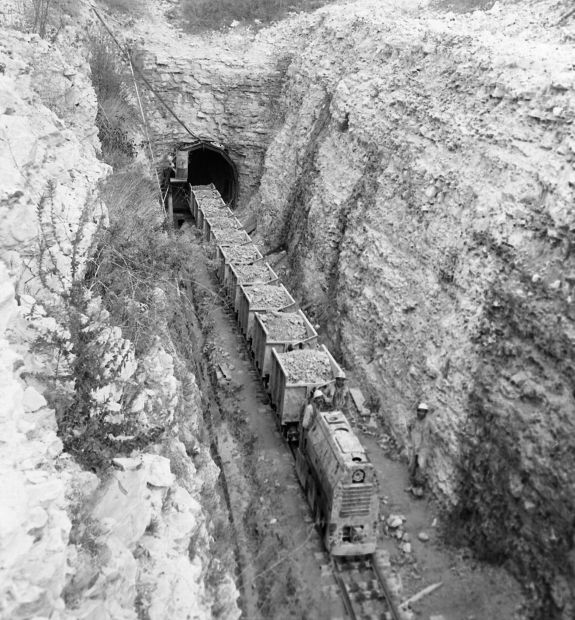
Image 7: Documentation of preparing sections of the main pipe of the National Water Carrier on "Line 108," named for its 108-inch diameter (approx. 274 cm), prior to assembly and connection. Line 108 was laid over 60 km from the Menashe Tunnel to the regulation station near Rosh HaAyin – the "Neve Yarkon" station. (NCHS\493924)

Image 8: Tarring works on the National Water Carrier pipes on "Line 108." (NCHS\493975)

👉Join one of my (quiet) Channels - Israel's History, Society & Culture:
Telegram: https://t.me/nirtopper
--
---
----


Comments