
"The Old Man’s" Final Defeat: The Day David Ben-Gurion Discovered the Nation Had Moved On – The 1965 Elections

👉Elections reflect the essence and public discourse of its time, highlighting the transformations within society.
The elections for the 6th Knesset in 1965 were defined by the schism within the Mapai party and the fierce confrontation between David Ben-Gurion and his successor, Levi Eshkol. This clash, fueled by Ben-Gurion’s demand to reopen the investigation into "The Affair" and his growing doubts regarding Eshkol’s leadership, led to the founding of the Rafi party. These elections marked a pivotal turning point as the political map began to consolidate into two major blocs—the Alignment (Ma'arach) and Gahal—which would shape Israeli politics for decades to come.
The roots of the crisis were buried in the 1954 "Unfortunate Affair" (Esek HaBish), which continued to destabilize the political system years later. Ben-Gurion’s refusal to accept the findings of the "Committee of Seven," which had exonerated Pinhas Lavon, and his persistent demand for a judicial commission of inquiry, deepened the rift with the veteran party leadership. This tension culminated in the establishment of Rafi, joined by the "Young Guard"—figures who sought to challenge the party apparatus, reform the electoral system, and promote a pragmatic, modern approach.
Simultaneously, a significant move occurred on the right side of the political aisle: the General Zionists joined the Herut movement to form a joint list called Gahal (the Herut-Liberal Bloc). While it did not pose an immediate threat to the ruling party, the system began gravitating toward two large blocs—the Alignment and Gahal—a process that signaled the beginning of Israel’s transition to a two-bloc political structure. Another formative event was the disqualification of the "Socialist List" by the Central Elections Committee; its primary activists were members of the outlawed Al-Ard movement. The Supreme Court upheld the disqualification in the landmark Yerdor ruling, which established the principle of "Defensive Democracy"—the state's right to prevent the electoral participation of a list that seeks to undermine its very existence.
The campaign took place against a backdrop of significant economic shifts: the end of German reparations and government restraint policies that paved the way for a deep recession (Mitun). On the security front, the completion of the National Water Carrier in 1964 led to escalating tensions over water sources in the north. Socially, ethnic polarization and the "communal divide" began to surface, bringing issues of discrimination and political representation to the fore—tensions that would only intensify in the following decade.
On election day, voter turnout was exceptionally high at approximately 83%. The Alignment won 45 seats, while Rafi secured only 10—a result that confirmed Eshkol's victory and effectively signaled the end of Ben-Gurion's political career. However, those 45 seats actually narrowed Eshkol’s coalition-building options, and it took over two months to form a government. The resulting coalition included five factions with a majority of 75 MKs, tasked with addressing the economic recession and growing border tensions. Later, on the eve of the 1967 Six-Day War, the coalition was expanded into a National Unity Government that included both Rafi and Gahal—an unprecedented union of political rivals born out of a national security crisis.
👉For more insights into the history of elections in Israel:
--
---
----
Image 1 – Shimon Peres, David Ben-Gurion, and Moshe Dayan at the founding convention of Rafi, 1966. Meitar Collection, National Library of Israel. Source: Meitar Collection / National Library of Israel / The Pritzker Family National Photography Collection, CC BY 4.0, via Wikimedia Commons.

Image 2 – The front page of the Gahal platform. Full document (Hebrew): https://www.idi.org.il/media/6443/%D7%92%D7%97%D7%9C-1965.pdf

Image 3 – 1965 Elections - Data.
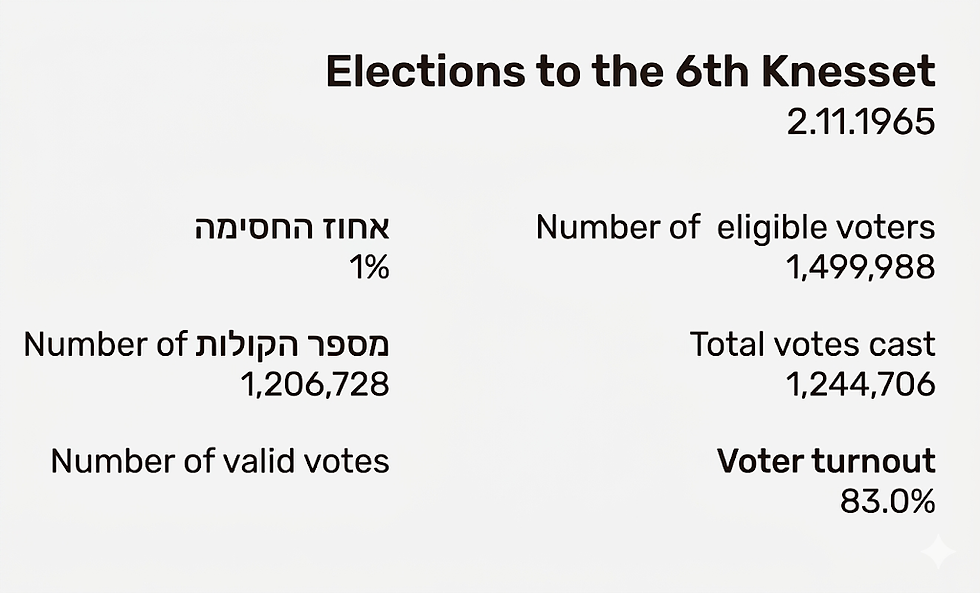
Image 4 – 1965 Election Results.

👉Join one of my (quiet) Channels:
Telegram: nirtopper.com/telegram-channel
Whatsapp: nirtopper.com/whatsapp-channel
👉Rich content available for you on my Blog; Israel's History, Society & Culture:
--
---
----
#nir_topper #tourguide #history #society #culture #israel #travel #elections #knesset #Parliament #Government #Politicalscience #Politics #middleeast #IsraeliPolitics #IsraelHistory #Zionism #MiddleEastPolitics #SocialSociety #Leadership #Democracy #Statehood #Research #MiddleEastHistory #Leaders #Policy #SocialSciences #PublicAffairs #ZionistHistory #Diplomacy #ניר_טופר #היסטוריה #חברה #תרבות #ישראל #טיולים #בחירות #כנסת #פרלמנט #ממשלה #פוליטיקה #מנהיגות #ציונות