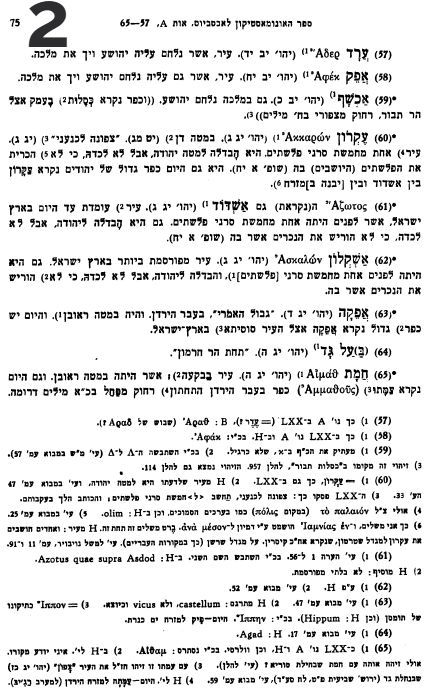
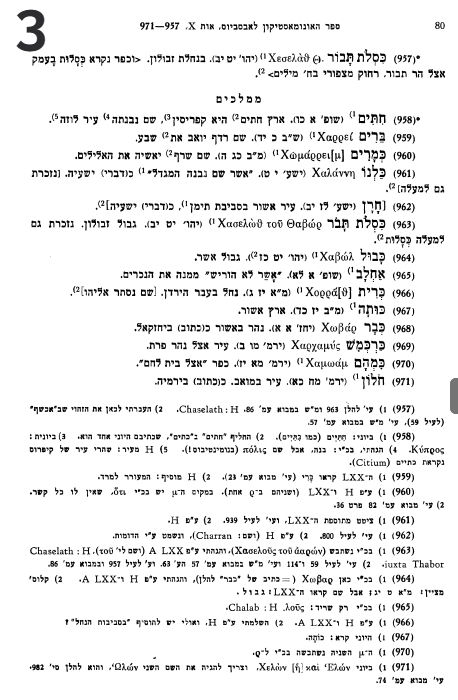
Eusebius's "Onomasticon"

The "Onomasticon" (Greek: book of place names; full title: "On the Place Names in Holy Scripture"), composed by Eusebius of Caesarea around 324 CE, is one of the keys through which we understand the historical geography of the Land of Israel today. It is a gazetteer (a geographical dictionary) of the Land of Israel and Transjordan in antiquity. Its importance goes far beyond that of a standard historical text: it was intended as an interpretive tool for biblical scholars, accurately documenting the landscape and place names of the land during the Late Roman period.
Eusebius, who lived between 260 and 339 CE (according to scholarly estimates), was the Bishop of Caesarea, considered one of the greatest scholars of his time, and the father of Church history. He took upon himself a monumental task: to compile all the place names—cities, villages, mountains, streams, and regions—appearing in the Hebrew Bible (and to some extent, the New Testament), and to identify their locations in the reality of his own time. The result is an alphabetical list of hundreds of geographical entries in the Land of Israel and its surroundings.
What makes the Onomasticon such a fascinating and critical document for researchers and archaeologists in modern-day Israel is Eusebius's working method. He did not settle for merely listing names; he provided concrete location data. He described the location of each settlement relative to the major cities of the era—most notably Jerusalem, Beit Guvrin (Eleutheropolis), Shechem (Neapolis), Legio, and Heshbon—using distances measured in Roman miles, noting compass directions, and employing various expressions of proximity ("adjacent to," "between X and Y," etc.).
In addition to geographical location, Eusebius frequently noted the contemporary name of the place at that time, and occasionally added invaluable demographic information. He documented, for example, which villages were inhabited by Jews, where Samaritans lived, and which settlements were Christian. It must be emphasized, however, that this documentation is anecdotal rather than systematic: thus, only about eleven Jewish villages, two Christian ones, and one Samaritan village are recorded in the Onomasticon. These records provide us with a rare "snapshot" of the population in the Land of Israel at the end of the Roman period—during the reign of Constantine, when Christianity began to gain power but had not yet become the exclusive, official religion of the Roman Empire.
Thanks to this work, modern scholars of the Land of Israel have been able to identify dozens of tells and ruins across the country, linking them to their original ancient settlement names. For example, Eusebius's description of Arad—"twenty miles from Hebron, four miles from Malatha"—perfectly matches the location of Tel Arad and aided in its identification. Eshtemoa, which Eusebius describes as a large Jewish village in the southern hill country, was identified with as-Samu' (today's es-Samu), where the remains of a magnificent Roman-Byzantine era synagogue were indeed uncovered. Emmaus was identified with Nicopolis based on the data Eusebius provided in the Onomasticon, and extensive Roman-Byzantine remains have since been excavated at the site. Tel e-Judeideh in the Shephelah was identified by Yohanan Aharoni as Moresheth-Gath, based on Eusebius's description placing it five miles from Beit Guvrin on the road to Lod. Finally, the ancient Christian site of Emmaus, whose location Eusebius describes relative to Jerusalem and Eleutheropolis, has served as the focal point for prolonged archaeological discussions that continue to this day.
Eusebius's Onomasticon serves to this day as a bridge between ancient texts and the soil of the land, constituting a fundamental working tool in the study of Israel's archaeology, geography, and history.
--
---
----
👉Join one of my (quiet) Channels:
Telegram: nirtopper.com/telegram-channel
Whatsapp: nirtopper.com/whatsapp-channel
👉Rich content available for you on my Blog; Israel's History, Society & Culture:
--
---
----
Image 1 - Portrait of Eusebius of Caesarea holding a scroll (a symbol of his wisdom), 6th century CE. Source: By Unknown, Public domain, via Wikimedia Commons

Images 2, 3 - Sample pages from Eusebius's Onomasticon, translated by E. Z. Melamed. Published by: Mandel Institute for Jewish Studies.