
From Cairo’s Caliph to Galilee’s High-Tech: How an 11th-Century Secretive Group Became Israel’s Backbone?
- Nir Topper

- Mar 24
- 5 min read
The Druze community, which refers to itself as "Al-Muwahhidun" (The Unitarians), is one of the most fascinating ethno-religious groups in the Middle East. The roots of their faith are planted in 11th-century Fatimid Egypt, emerging in 1017 from Shia-Ismaili Islam under the rule of Caliph Al-Hakim bi-Amr Allah. This formative period was characterized by the "Da’wa" (The Call to Faith), which spanned approximately 26 years, during which believers were invited to join the new religion. In 1043, the "Gates of the Da’wa" were closed by the movement's leader, Baha al-Din al-Muqtana. Since then, the community has remained a closed group that does not accept proselytes, a move intended to preserve the purity of the faith and protect the community from persecution. To this day, the only way to be part of the Druze community is to be born to both a Druze mother and father.
A Philosophy of Unity and Cosmic Principles
At the heart of the Druze faith lies a monotheistic philosophy that emphasizes the absolute unity of God, who is considered beyond any human description or definition. This theological system is symbolically represented by five colors found in the Druze flag and the five-pointed star. Each color symbolizes a cosmic principle known as a "Hadd" (Limit/Boundary): Green: The Universal Intellect (Al-Aql), Red: The Universal Soul (Al-Nafs), Yellow: The Word/Truth (Al-Kalima), Blue: The Precedent/Cause (Al-Sabiq), White: The Implementation/Result (Al-Tali).
The Druze do not follow the five pillars of Islam in their conventional form. Instead, they are committed to seven commandments that blend principles of faith with moral obligations. Foremost among these are "Sidq al-Lisan" (Truthfulness of the Tongue)—the duty to speak the truth—and "Hifz al-Ikhwan" (Protection of the Brethren), which expresses a deep sense of mutual responsibility within the community. This solidarity is famously described in Druze lore through the metaphor of a copper tray: "Wherever you strike it, the entire tray rings and echoes."
Reincarnation and Social Structure
The belief in reincarnation ("Taqammus") is a unique pillar that shapes the Druze consciousness. According to this belief, the soul is eternal, and upon death, it immediately transitions to the body of a newborn Druze infant. This creates a deep, unbreakable bond of brotherhood between all members of the community worldwide. This concept also explains their stoic attitude toward death, which is viewed merely as "changing one's garment." Indeed, the word Taqammus is derived from Qamis, meaning a shirt or an outer garment.
Socially, the community is divided into two groups: the "Uqqal" (the Initiated/Wise), who are dedicated to the Druze doctrine, dress modestly, maintain high moral integrity, and gather on Thursday evenings in modest houses of prayer called "Khilwa" for prayer and meditation; and the "Juhhal" (the Uninitiated), the majority of the community who are not exposed to the inner secret scriptures.
A History of Autonomy and Leadership
Druze history is a saga of struggles for freedom and autonomy in isolated mountainous regions. In the early 17th century, under the rule of Emir Fakhr al-Din II of the Ma'an family, a Druze leader reached the peak of political power ever achieved by a member of the community. Though he served as a governor for the Ottomans, he effectively ruled an extensive autonomous region covering most of Lebanon, nearly all of Syria, and significant parts of the Land of Israel—from the plains of Antioch in the north to Safed in the south.
The 20th century brought the "Great Syrian Revolt" (1925–1927), led by Sultan al-Atrash. What began as a Druze uprising in Jabal al-Druze expanded into a Syrian national revolt against the French Mandate, making Al-Atrash a lasting symbol of courage and resistance. These events established the Druze as a key geopolitical force in the region.
The Special Bond with the State of Israel
The unique relationship between the Druze and the State of Israel is often referred to as a "Covenant of Blood"—a term I personally dislike and believe does significant damage to the true essence of the bond between the Druze, Jews, and the State. This connection was forged as early as the British Mandate period in the 1930s and deepened in the 1940s. Since 1956, mandatory military service has been applied to young Druze men—a step taken following an initiative by community leaders led by the spiritual leader at the time, Sheikh Amin Tarif.
The recruitment rate among Druze men is approximately 85%—among the highest in Israel. Today, members of the community can be found in every key position of leadership and excellence in Israel: in academia, the judiciary, the economy, high-tech, entrepreneurship, and education. Many serve in the highest ranks of the security forces. The current spiritual leader, Sheikh Mowafaq Tarif (the grandson of Sheikh Amin Tarif), has held the position since 1993. His seat, like that of his late grandfather, is in the village of Julis—a stunning and charming place that is very dear to me, primarily because of its extraordinary people.
Modern Demographics and Social Revolution
Recent demographic data points to a profound social revolution within the community in Israel. There has been a sharp decline in the fertility rate, which stood at approximately 1.64 children per woman in the first half of 2024—among the lowest of the recognized religious groups in Israel, similar to that of the Christians (1.62). Concurrently, there has been a significant increase in the number of Druze students in higher education since 2000, with Druze women making up an ever-growing portion of the student body.
As of 2024, approximately 123,000 Druze live in Israel (excluding the Golan Heights), mostly concentrated in the Galilee and Carmel regions. Worldwide, their numbers are estimated between 800,000 and over a million, with the primary concentrations in Syria (mainly in Jabal al-Druze), Lebanon (the Chouf Mountains), and Israel.
The Golan Heights: A Historical Shift
Significant historical and political changes are also evident in the Golan Heights. Since the application of Israeli law to the Golan in 1981, the Druze living in the four permanent villages—Majdal Shams (the largest), Buq'ata, Mas'ade, and Ein Qiniyya—have been defined as permanent residents of Israel. This status grants them full civil and social rights, except for those reserved for citizens (such as voting in national elections).
However, Golan Druze have the right to apply for Israeli citizenship. The Golan Druze community, now numbering about 29,000, has undergone dramatic geopolitical shifts: the Syrian Civil War, the events of October 7, 2023, the tragic massacre of children in Majdal Shams in July 2024, and the recent fall of the Assad regime. All these factors have led to an unprecedented surge in applications for Israeli citizenship. Today, approximately 20.45% of the Druze in the Golan (about 6,000 people) hold full Israeli citizenship—compared to less than 10% in 2011.
Image 1: Sheikh Amin Tarif, 1950. Born in 1898 in the village of Julis. In 1988, marking 60 years of his leadership, Druze leaders gathered and crowned him the sole leader of the Druze throughout the Middle East. Sheikh Tarif was awarded the Israel Prize in 1990 for his outstanding contribution to the Druze community, the State of Israel, and interfaith partnership. Source: Wikipedia, Amin Tarif. BRAUNER TEDDY, Public domain, via Wikimedia Commons.
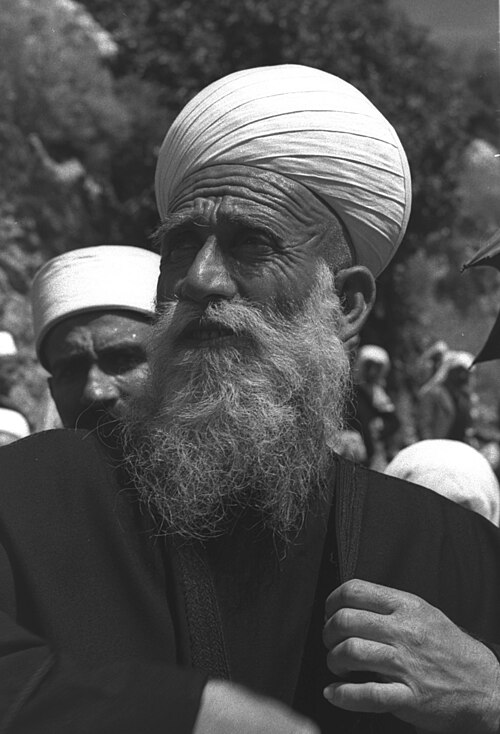
Image 2: Sheikh Amin Tarif with David Ben-Gurion during a visit to Julis, 1951.

Image 3: The Druze Flag.

Image 4: Distribution of Druze villages in Israel.


Comments