
Brief – One concept a day. Today: Emmaus. How far is it from Jerusalem?
- Nir Topper

- Apr 11
- 3 min read
The village of Emmaus holds a place of honor in Christian tradition as part of the account of the "Apparition on the Road to Emmaus." According to the New Testament, this is where Yeshua appeared to two of his disciples following his resurrection. Despite its religious significance, the exact location of the village remains one of the most fascinating geographical puzzles in the Land of Israel. The source of this ambiguity lies in conflicting versions found in the manuscripts of the Gospel of Luke (one of the four Gospels of the New Testament). Most manuscripts, including some of the oldest, cite a distance of 60 stadia (approximately 11 km) from Jerusalem. However, other manuscripts—most notably the Codex Sinaiticus—record a distance of 160 stadia (approximately 30 km).
A word on units of measurement: The earliest known versions of the New Testament were written in Greek, which most scholars believe to be the original language of the text. The term used in the Gospel of Luke (24:13) is σταδίους (stadious)—that is, stadia. "Ris" is a Talmudic term (1/30 of a Parsa, roughly 266 meters), which differs from the Greek stadium (approximately 185 meters). While some Hebrew translations of the New Testament use "Ris" to translate σταδίους, this is an imprecise conversion as they represent different units.
Most scholars believe that "60 stadia" is the original version of the text. They suggest that the "160 stadia" variant was introduced by later scribes who sought to align the scripture with the traditional identification of Emmaus as the city of Nicopolis in the Ayalon Valley. This textual discrepancy led to the historical identification of Emmaus with several different sites.
Today, this textual mystery is reflected in several pilgrimage sites, each offering a different interpretation of the New Testament account:
Emmaus Nicopolis (Latrun): Located in the Latrun region, this site aligns with the 160-stadia version. It is an impressive archaeological site featuring the remains of Byzantine and Crusader churches and ancient mosaics.
Abu Ghosh and Al-Qubeibe: These sites align with the 60-stadia version. In Abu Ghosh, there is a church built by the Crusaders (the Hospitallers) around 1140. In Al-Qubeibe, located northwest of Jerusalem, stands a church established by the Franciscans in 1902 upon the ruins of an ancient Crusader structure.
The multiplicity of sites identified as Emmaus illustrates the profound connection between the written word and the physical landscape. It demonstrates how linguistic and translational shifts in the New Testament have shaped, and continue to shape, the religious and cultural map of the Holy Land.
--
---
----
👉Join one of my (quiet) Channels:
Telegram: nirtopper.com/telegram-channel
Whatsapp: nirtopper.com/whatsapp-channel
👉Rich content available for you on my Blog; Israel's History, Society & Culture:
Image 1 – The various locations proposed as the identification of the Emmaus mentioned in the New Testament. Source: Itzuvit, CC BY-SA 3.0, via Wikimedia Commons. <https://creativecommons.org/licenses/by-sa/3.0>

Image 2 – St. Mary of the Resurrection Church at the Benedictine Monastery in Abu Ghosh. One of the identified locations of Emmaus. Photo: Nir Topper.

Video – The lovely Father Olivier demonstrating the incredible Crusader acoustics. St. Mary of the Resurrection Church at the Benedictine Monastery in Abu Ghosh. Filmed by Nir Topper.
Image 3 – Signs pointing to Emmaus Nicopolis (Latrun). Photo: Nir Topper.

Image 4 – Emmaus Nicopolis (Latrun) - The southern apse of the Byzantine church. To the left, the southern wall of the Crusader church is visible, which covered only a portion of its predecessor's area. Source: Avishai Teicher, CC BY-SA 2.5. https://he.wikipedia.org/w/index.php?curid=663229

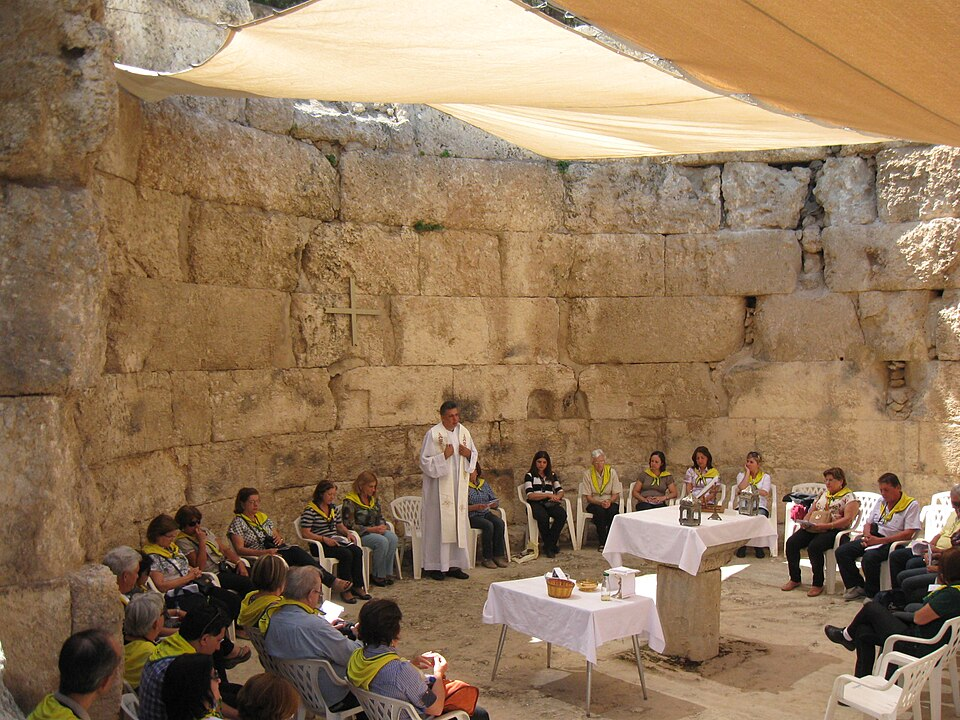
Image 5 – Emmaus Nicopolis (Latrun) - A ceremony inside the Crusader church. Source: Ori~, Attribution, via Wikimedia Commons. https://commons.wikimedia.org/w/index.php?curid=19375023
--
---
----


Comments