
Holy Water in the "Castle of the Jews"
- Nir Topper

- 9 hours ago
- 3 min read
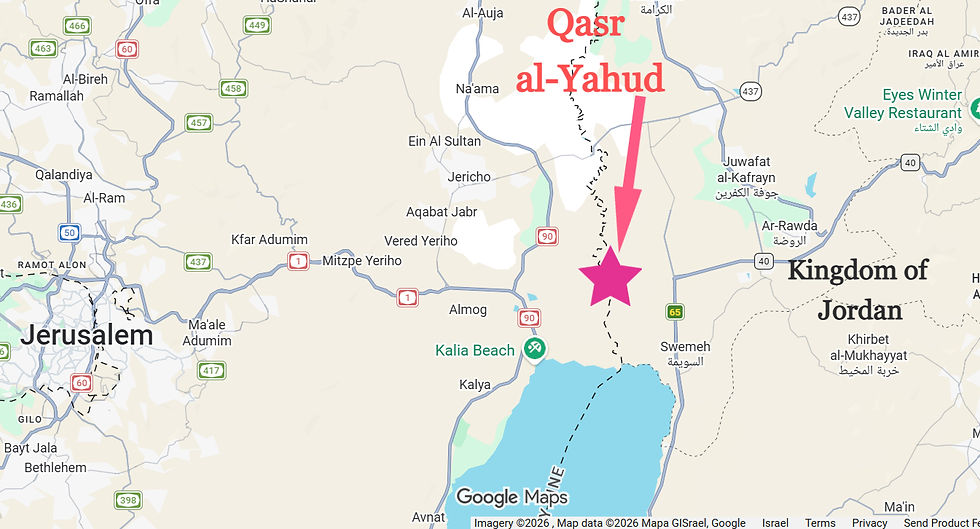
At the edge of the Judean Desert, about 7 kilometers east of Jericho as the crow flies, just before the Jordan River flows into the Dead Sea, along a narrow, short, and hidden strip of riverbank—thousands of years of history are concentrated, holding rare significance for Jews and Christians worldwide. "Qasr al-Yahud" (Arabic: قصر اليهود - "The Castle (or Palace) of the Jews") is a physical and spiritual meeting point where history was shaped.
The Arabic name "Qasr al-Yahud" was originally given to the Church of St. John the Baptist located at the site, and today it is used to designate the entire complex. According to Jewish tradition, this is the exact spot where the Israelites crossed the Jordan River as they entered the Land of Canaan after forty years of wandering in the desert, led by Joshua bin Nun. In terms of the biblical narrative and tradition, this is the "front door" through which the people of Israel entered the Land of Israel. Another Jewish tradition recounts the parting of Elijah the Prophet from his disciple Elisha, and Elijah's ascent to heaven in a whirlwind on a chariot of fire, occurring at this very same spot.
For the Christian world, this is one of the holiest sites on earth (the third most important, after the Church of the Holy Sepulchre and the Church of the Nativity). According to tradition, on the eastern bank at this location lies "Bethabara," the place where John the Baptist operated and where he baptized Jesus Christ in the waters of the Jordan. This event is considered the defining moment that launched the public ministry of Jesus Christ. Every year, hundreds of thousands of pilgrims from around the globe arrive at the site, donning white robes and entering the waters of the Jordan River to recreate the ancient baptismal rite, accompanied by profound emotion and spiritual elation that is hard to remain indifferent to.
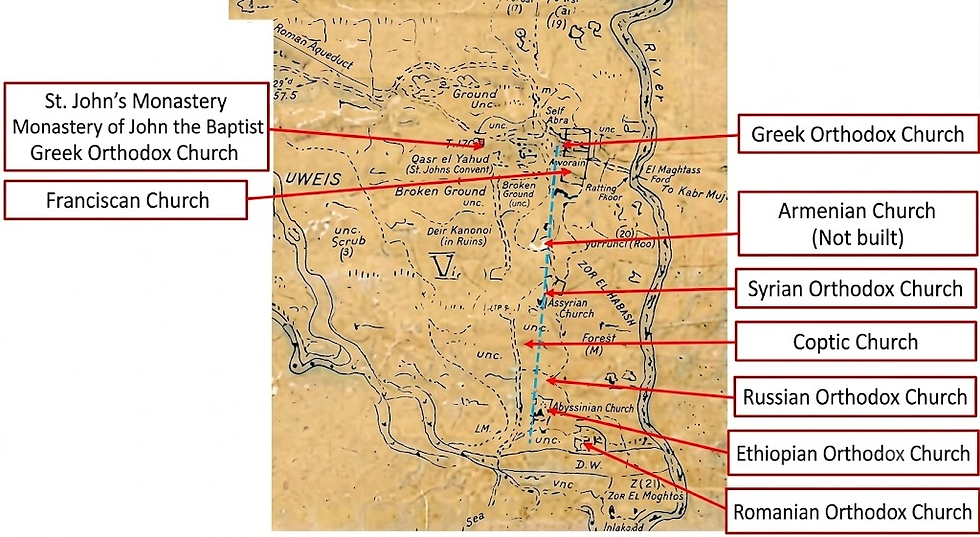
"Qasr al-Yahud" is situated on the political border between the territory under Israeli control and the Kingdom of Jordan. For decades, the site was completely closed off. The churches were abandoned, sustained bullet damage, and were surrounded by barbed wire fences and dense minefields. In 2011, the baptismal site itself was reopened to pilgrims, but the adjacent monasteries remained barricaded. In 2016, a complex and extraordinary project was launched, led by the Israel National Mine Action Authority in the Ministry of Defense, together with the international HALO Trust organization. By the end of 2018, three out of the seven mined monasteries were cleared. The clearance process is not yet fully completed, and most of the monasteries are still not open for free visitation. However, the project, which required delicate cooperation and coordination, allowed for the gradual opening of the site to the general public under the management of the Nature and Parks Authority.
--
--
----
👉Join one of my (quiet) Channels, stay updated:
Telegram: nirtopper.com/telegram-channel
Whatsapp: nirtopper.com/whatsapp-channel
👉Rich content available for you on my Blog; Israel's History, Society & Culture:
--
---
----
Photos of "Qasr al-Yahud." On the other side, the corresponding Jordanian site can be seen. Photography: Nir Topper.


Patriarch Theophilos III of Jerusalem arriving at Qasr al-Yahud to conduct Mass, March 2010.
Source: Ori~, Attribution, via Wikimedia Commons.

A 1934 British map showing the layout of some of the churches west and south of the baptismal site. During the Mandate period, the path to the churches near the Monastery of St. John the Baptist was constructed. Between the 1980s and the 2010s, the State of Israel paved the British path, which begins east of the monastery (the dashed blue line marks the current path). Source: The British Mandate, Public domain, via Wikimedia Commons/
Map of the area


Comments